If you’ve ever walked past a storefront, event venue, or residential space with glowing, bendable signage, chances are you’ve seen flexible LED neon lights. As a supplier who’s worked directly with installers, designers, and property managers for years, I’ve lost count of how many times someone’s asked me, “Is IP65 and IP67 the same thing for these lights? Because I don’t want my sign to die in the rain.” It’s a fair question—most people don’t dig into IP ratings beyond knowing they relate to water resistance, and when it comes to flexible neon, that gap in understanding can lead to costly mistakes, especially for outdoor projects. Let’s break this down the way I explain it to my clients, no confusing jargon, just real-world context. Flexible LED Neon Lights

First, let’s start with what IP ratings actually mean. IP stands for Ingress Protection, a standardized system created by the International Electrotechnical Commission (IEC) to measure how well a device stands up to solid particles (like dust) and liquids (like water). The first number in the rating is for solid ingress, the second for liquid. For flexible LED neon lights, nearly all of our models have a first number of 6—meaning they’re “dust-tight.” That’s a big deal: unlike cheaper neon alternatives that have gaps where dust can seep in and clog LEDs, IP6-rated flexible neons don’t let any dust penetrate the outer housing, so they hold up long-term even in sandy or dry climates. The difference between IP65 and IP67 is entirely in that second number, the liquid resistance part. That’s where most mix-ups happen, so let’s focus there.
IP65 is the lower of the two liquid protection ratings for flexible neon. The “5” means the light is protected against low-pressure water jets from any direction. To hit that rating, a light has to withstand water being sprayed at a pressure of 10 liters per minute at a distance of 3 meters for 3 minutes straight. That’s not just a light drizzle—it’s a garden hose aimed at the light, or heavy rain, or even temporary splashes from a pool, a fountain, or a cleaning session. For indoor uses, IP65 is more than enough: an indoor sign near a kitchen sink, a retail display close to a door that gets damp from rain, or a wall feature in a gym where people might spill water on it will never have to handle that direct, high-volume spray. But here’s the caveat with IP65 flexible neon: it’s not meant to be fully submerged. The rating only covers water hitting the surface, not being surrounded by it. So if an IP65 light gets trapped under a flooded sidewalk during a storm, or someone accidentally installs it in a planter that holds standing water, it will take on water and stop working.
Now IP67: that’s a step up. The “7” in the rating means the light is protected against immersion in water up to 1 meter deep for 30 minutes. That’s a bigger test. To earn IP67, a flexible neon has to be sealed tightly enough that no water seeps in when it’s fully submerged, not just sprayed. For projects that are outdoors, especially those that might be exposed to longer periods of moisture, that makes a huge difference. Let’s say you’re building a sign for a patio bar that gets covered in snow in the winter, or a shoreline store sign that’s occasionally splashed by high waves, or a commercial lighting feature that’s installed in a pool cabana where it might be exposed to standing water. IP67 flexible neon is built for that. But here’s a common myth I run into: some clients think IP67 means “waterproof forever,” and that’s not true. The IEC sets the immersion test at 1 meter for 30 minutes; if you submerge an IP67 light deeper than that, or for longer than 30 minutes, the seal can fail. That’s why even IP67 flexible neon isn’t meant to be permanently submerged, like under a lake or in a water feature with continuous water flow.
Let’s put this into real examples of when to use each, because that’s what matters most to people buying these lights. If your project is indoor: a custom sign for a coffee shop interior, a wedding backdrop that’s only used indoors, a bedroom accent wall, or a signage strip along a hallway that never gets wet. IP65 is perfect here. It’s more cost-effective than IP67, which has extra sealing layers that drive up the price, and it will hold up to the occasional spill, or the damp air from a bathroom it’s installed near. I’ve had clients who installed IP65 lights in their retail storefronts just a few feet from a loading dock where rain splashes on them daily, and they’ve held up for 4 years with zero issues, as long as the dock isn’t flooding.
If your project is outdoor, here’s where you have to be careful. If it’s a sign that’s mounted 10 feet up on a building, away from ground-level splashes, and only exposed to rain, IP65 can work—wait, no, let me correct that: actually, for signs mounted higher than 8 feet, even heavy rain is just spray, so IP65 is often sufficient. But if your sign is mounted at ground level, like a storefront awning near a parking lot, or it’s going to be covered in snow for months, or it’s near a sprinkler system that sprays it regularly, go for IP67. Last year, a client came to me after his IP65 sign at a golf course got ruined when the sprinklers ran for 6 hours straight—water pooled around the base, seeped into the edges, and the LEDs died within a week. He swapped those for IP67 and hasn’t had a problem since. Another example: a pool installation where lights are installed along the edge of the pool deck, where they might get splashed when someone jumps in, but never submerged. IP67 is the right call there, because it can handle accidental immersion without failing.
Now, let’s talk about the build difference between the two, because that’s why the price varies. Flexible LED neon is made of a silicone outer tube, right? The LEDs are mounted on a flexible PCB, and there are wires running through the tube. For IP65, the seal is typically a simple adhesive between the silicone tube and the end caps, and the wires are sealed with heat shrink tape. For IP67, the seal is way more robust: the silicone ends are molded directly onto the tube, not just glued, and the wires are sealed with a waterproof epoxy, not just tape. The silicone itself is also thicker on IP67 lights, to handle the pressure of immersion without cracking. That extra layer of sealing is why IP67 is better for harsher conditions, but it also means IP67 lights can be slightly stiffer than IP65, which is something to keep in mind if you’re working with very tight curves for a custom sign.
I always tell clients to ask themselves two questions before choosing between IP65 and IP67: 1) Will the light ever be fully surrounded by water, even temporarily? If yes, go with IP67. 2) Will the light only be exposed to water spraying on it from above or the side, no standing water? Then IP65 will work, as long as it’s mounted correctly. The mistake people make is either overbuying—paying extra for IP67 when they don’t need it, just because they think it’s “better”—or underbuying, going with IP65 for a project that’s going to get submerged. I’ve seen both scenarios end badly. A few months back, a homeowner ordered IP65 lights for a backyard sign, left them out during a heavy flood, and emailed me saying half the lights were dead. We exchanged them for IP67, and they’ve worked through two more storms since.
Another thing to note: IP ratings don’t just apply to the neon tube itself, but also to the power supply, which is just as important. Even if your flexible neon is IP67, if you use a standard non-waterproof power supply, the whole system will fail if water gets to the power cord. So make sure whatever power supply you use matches the rating of your lights. For IP65 lights, a waterproof power supply rated for indoor/outdoor use works, but for IP67, you’ll want a power supply that’s also rated for immersion, or at least fully sealed to match the light’s rating.
Let me address a common question I get: can you turn an IP65 light into an outdoor light? Short answer: no, not safely. The seal on IP65 isn’t made to handle standing water, even for a few minutes, so trying to seal the ends yourself with silicone won’t hold up long-term. I’ve seen clients try that, and within a month, the silicone cracks, water seeps in, and they end up replacing the lights anyway. It’s not worth the hassle.
At the end of the day, the right choice comes down to your specific project. If you’re looking for a flexible neon sign for a home, retail store, or event space that’s mostly indoor or only exposed to light rain and splashes, IP65 is a cost-effective, reliable option. If it’s an outdoor sign, pool feature, or any project where the light might be exposed to standing water or longer periods of moisture, IP67 is the safe, long-lasting choice. I’ve been supplying flexible LED neon lights for over 8 years now, and I’ve helped hundreds of clients pick the right IP rating for their needs, and I always encourage anyone who’s unsure to reach out. I can walk you through the specifics of your project, help you calculate how much you need, and answer any questions you have about installation or care.
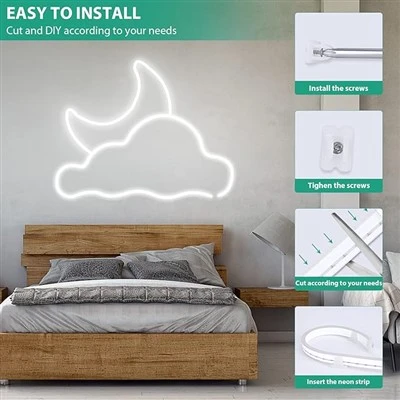
If you’re planning a project—whether it’s a small residential accent or a large commercial installation—don’t leave your lights’ durability to chance. Reach out to discuss your needs, and we’ll make sure you get the right flexible neon lights that fit your budget and project requirements.
RGB Neon LED References
IEC 60529: Degrees of protection provided by enclosures (IP Code). International Electrotechnical Commission, Geneva, 2013.
Flexible LED Neon Light Performance Testing Report, Lighting Research Center, Rensselaer Polytechnic Institute, 2022.
Outdoor Signage Durability Study, National Signs Association, 2023.
Qianxin Meichen Optoelectronic Technology (Huzhou) Co., Ltd.
As one of the most professional flexible led neon lights manufacturers and suppliers in China, we also support customized service. With abundant experience, we warmly welcome you to buy bulk cheap flexible led neon lights in stock here from our factory. Quality products and low price are available.
Address: 3rd Floor, Building 4, Zhejiang Jiacheng Science and Technology Entrepreneurship Park, No. 656 Qixing Road, High-tech Zone, Wuxing District, Huzhou City, Zhejiang Province
E-mail: David18888@gmail.com
WebSite: https://www.china-neonsigns.com/
